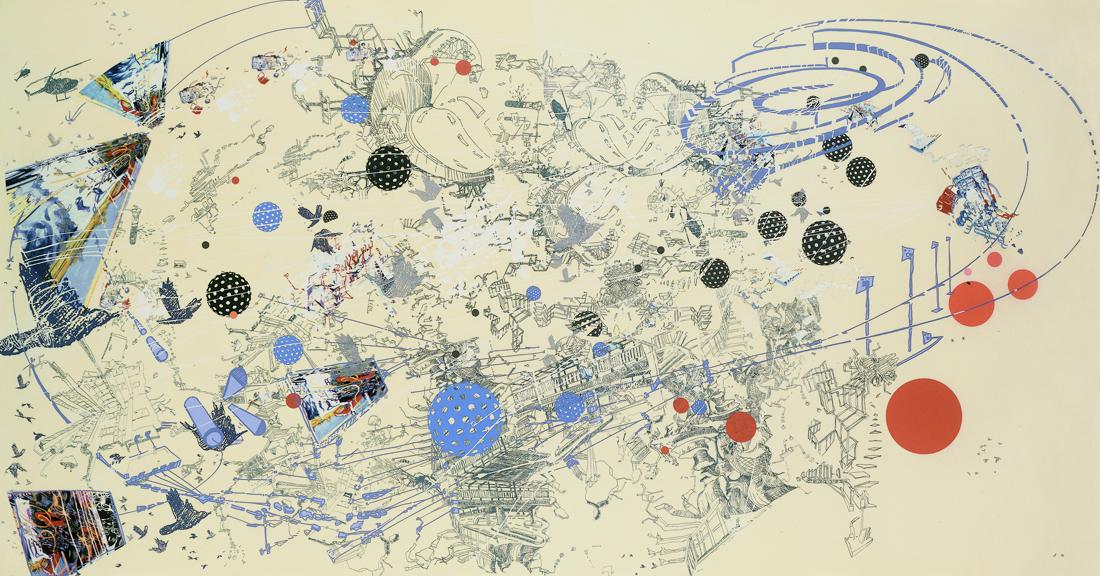
Sarah Sze, "Day", 2003. Offset lithograph and silkscreen. Copyright: Sarah Sze. Image credit: Sarah Sze Studio

Contagious Territories

2024-2030

Funded by the Startersbeurs
(Leiden University Center for the Arts in Society)


Back to: Home page

Conference

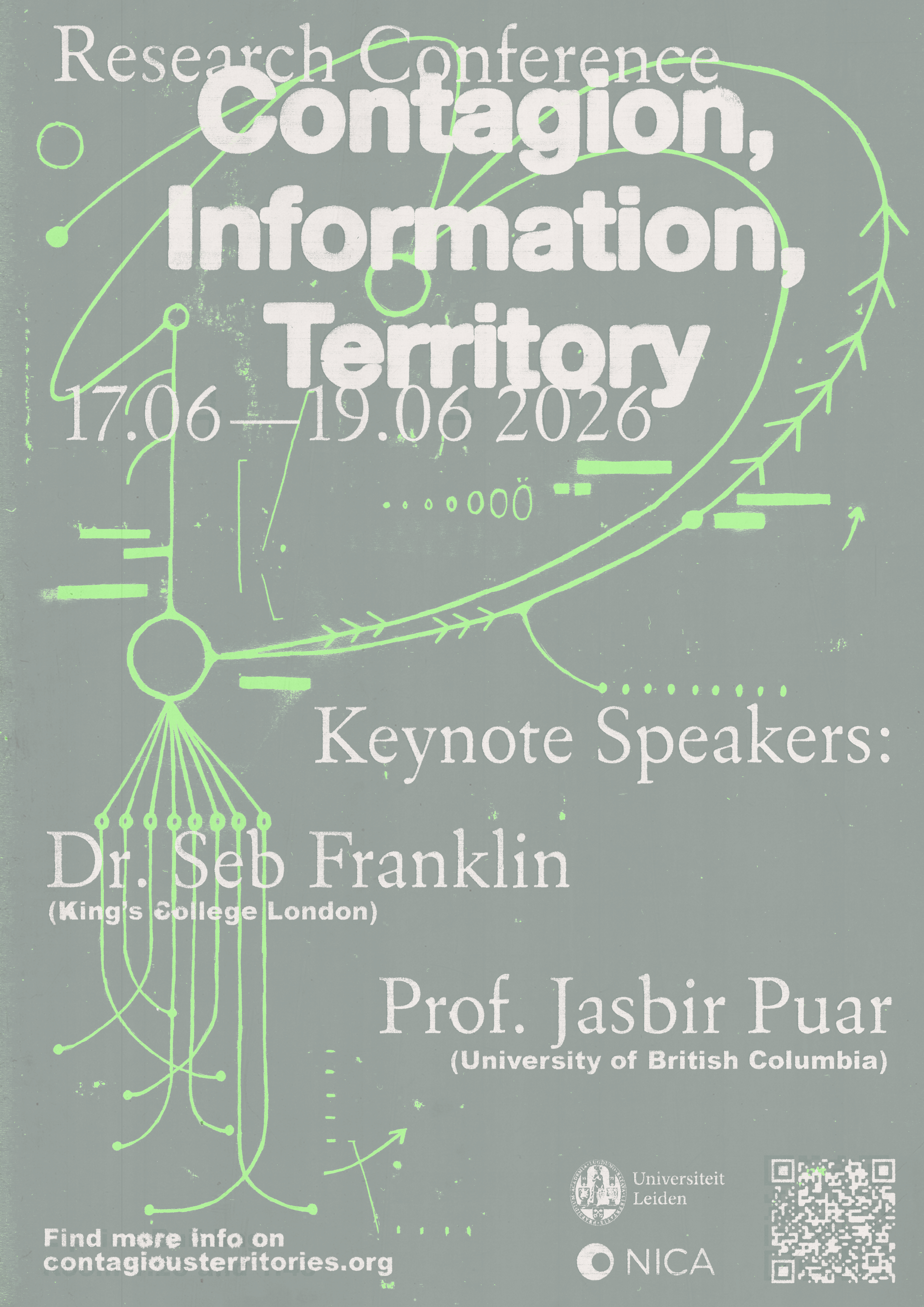
On this page, all information regarding the conference "Contagion, Information, Territory" can be found. Any news and updates surrounding the conference will be shared to this webpage in the months leading up to the event.

If you have any remaining questions or need additional information, please reach out to contagious.territories@hum.leidenuniv.nl.


Important dates and locations

Date: 17-19 June, 2026
Location: Leiden University

Deadline Call for Papers: 31 January, 2026


Call for Papers

Conference: Contagion, Information, Territory

As new forms of exclusion and colonialism are emerging and old apartheid policies reinvigorated, the movement of people, the spread of disease, and the circulation of information become ever more central to our understanding of war, politics, identity, and government. The war in Gaza and illegal occupation in the West Bank are a case in point. This conflict is not just territorial, it is informational, and the Israeli government employs strategies of withholding care and barring humanitarian aid to preemptively immunize Israel’s cultural and legal selfperception as a ‘uniquely’ Jewish nation-state, against Palestinian life. As the international movement of trans* and queer people is restricted in ways that bring to mind the late 20th century response to the HIV/AIDS crisis, gender and sex education are thought of as ‘infecting’ children with particular sexual preferences, or encouraging trans* identification in them. Meanwhile, the language of contagion is activated politically and by opposing factions. Where some speak of a “woke mind virus,” others attempt to make sense of fascist protests like the January 6th attack on the Capitol in 2020, or the 2025 extreme rightwing riots in The Hague, the Netherlands, as fueled by viral online discourse and contagious hatred of immigrants.

In response to these concerns, contagion, information, and territory emerge as central concepts of political analysis and critical thought. Contemporary artists and writers like Isadora Neves Marques, Tabita Rezaire, Michel Nieva, and Anne Boyer reflect on these convergences in their practice, and academic consideration of such work may help theorize them further. It is for this reason that we call for papers that seek to map the connections between contagion, information, and territory through critical analyses of cultural objects.

How do public health interventions, immunization policies, and biopolitical regimes help govern populations under conditions of uncertainty? Concepts of (auto-)immunity, and parasitism, have been central to discussions around biomedicine, territory, and democracy, and considerations of care, the viral, and vaccination have found new urgency during the COVID-19 pandemic (Cohen 2009; Esposito 2008; Serres 1982; Derrida 2004; Di Cesare 2021; Povinelli 2016). Angela Mitropoulos helps us wonder how insurance, contracts, and riskprediction have historically structured vulnerability and precarity along lines of gender, race, and capital (Mitropoulos 2012). Jasbir Puar has mobilized the notion of “debility” to critically examine discourses around a variety of crises, urging us to focus on the endemic nature of state sanctioned “debilitation” as part of biopolitical regimes of power and in the context of Palestinian rights (Puar 2017).

For this conference, we are particularly interested in scholarship that brings these concerns into dialogue with contemporary technological and political realities (Pasquinelli 2023; Amoore 2013; Parisi 2013). How do data infrastructures and algorithmic systems (re)produce social hierarchies and how do they relate to what Ramon Amaro refers to as “the black technical object” (Amaro 2023)? How can bio- and necropolitical configurations around human embodiment, along with their relationship to disease, harm, and contagion, be theorized in connection to processes of territoriality and critical analyses of datafication in this “technolibertarian age” (Mbembe 2021)? How does the transformation of European borders into “deathscapes” rely on a logic of securitization and immunization supported by digital infrastructures of control and racialized surveillance (Pugliese 2022; Stümer 2018; Browne 2015)?

In conversation with cybernetics, Sylvia Wynter reminds us that the Foucauldian framework around security requires further elaboration to confront how the category of “Man” has historically depended on racialized life and the enduring histories of plantation economy, colonialism, and chattel slavery (Wynter 2003 & 2018; Foucault 2007; Tsing 2021). Articulations of territory, anxieties around health, cleanliness and contagion, and regimes of information and datafication intersect, and give rise to an assemblage in which differentially racialized, gendered, classified, and categorized human and non-human figures emerge (Weheliye 2014; Gossett & Hayward 2020). In response to this assemblage that exists at the center of contemporary political, cultural, and social subjection and abjection, we invite paper proposals reflecting on the relationship between contagion, information, and territoriality.

Responses might encompass, but are not limited to:

We welcome submissions on these themes across fields and disciplines. Please submit abstracts for 20-minute presentations of 250 to 300 words, along with brief biographical notes (about 50 words) to contagious.territories@hum.leidenuniv.nl by January 31, 2026. We especially encourage queer, BIPOC, disabled, working class, and other marginalized scholars to apply. Notifications of acceptance will be sent by February 28, 2026. Please note that attendance at this conference will be inperson ONLY. For more information, please contact us at contagious.territories@hum.leidenuniv.nl.


References

Amaro, Ramon. The Black Technical Object: On Machine Learning and the Aspiration of Black Being. Sternberg, 2023.

Amoore, Louise. The Politics of Possibility: Risk and Security Beyond Probability. Duke UP, 2013.

Boyer, Anne. The Undying: Pain, Vulnerability, Mortality, Medicine, Art, Time, Dreams, Data, Exhaustion, Cancer, and Care. Farrar, Straus and Giroux, 2019.

Browne, Simone. Dark Matters: On the Surveillance of Blackness. Duke UP, 2015.

Cohen, Ed. A Body Worth Defending: Immunity, Biopolitics, and the Apotheosis of the Modern Body. Duke UP, 2009.

Derrida, Jacques. “Autoimmunity: Real and Symbolic Suicides: A Dialogue with Jacques Derrida,” in Giovanna Borradori, Philosophy in a Time of Terror: Dialogues with Jürgen Habermas and Jacques Derrida. Translated by Pascale-Anne Brault and Michael Naas, U of Chicago P, 2004, pp. 85–136. Di Cesare, Donatella. Immunodemocracy: Capitalist Asphyxia. semiotext(e), 2021.

Esposito, Roberto. Bíos: Biopolitics and Philosophy. U of Minnesota P, 2008.

Foucault, Michel. Security, Territory, Population: Lectures at the Collège de France, 1977–78, edited by Michel Senellart. Translated by Graham Burchell, Palgrave Macmillan, 2007.

Gossett, Che, and Eva Hayward. “Trans in a Time of HIV/AIDS.” TSQ: Transgender Studies Quarterly, vol. 7, no. 4, Nov. 2020, pp. 527–53, https://doi.org/10.1215/23289252-8665171.

Marques, Isadora Neves. A Mordida [The Bite]. 2019.

Mbembe, Achille. “The Earthly Community: Colonality of Infrastrucutre.” e-flux, Oct., 2021, https://www.e-flux.com/architecture/coloniality-infrastructure/410015/the-earthly-community.

Mitropoulos, Angela. Contract and Contagion: From Biopolitics to Oikonomia. Minor Compositions, 2012.

Mitropoulos, Angela. Pandemonium: Proliferating Borders of Capital and the Pandemic Swerve. Pluto Press, 2020.

Nieva, Michel. Dengue Boy. Translated by Rahul Bery, Serpent’s Tail, 2025.

Parisi, Luciana. Contagious Architecture. Computation, Aesthetics and Space. MIT Press, 2013.

Pasquinelli, Matteo. The Eye of the Master: A Social History of Artificial Intelligence. Verso, 2023.

Perera, Suvendrini, and Joseph Pugliese, editors. Mapping Deathscapes: Digital Geographies of Racial and Border Violence. Routledge, 2022.

Povinelli, Elizabeth A. Geontologies: A Requiem to Late Liberalism. Duke UP, 2016.

Puar, Jasbir. The Right to Maim: Debility, Capacity, Disability. Duke UP, 2017.

Rezaire, Tabita. Deep Down Tidal. 2017.

Serres, Michel. The Parasite. Translated by Lawrence R. Schehr, Johns Hopkins UP, 1982.

Stümer, Jenny. “The Dead are Coming: Border Politics and Necropower in Europe,” Cultural Politics 14, no. 1, 2018.

Tsing, Anna L.. “Towards a Theory of Non-Scalability.” Multitudes, 2021/1, no. 82, 2021. pp. 65–71. https://doi.org/10.3917/mult.082.0065.

Weheliye, Alexander G. Habeas Viscus: Racializing Assemblages, Biopolitics, and Black Feminist Theories of the Human. Duke UP, 2014.

Wynter, Sylvia. “Beyond Liberal and Marxist Leninist Feminisms: Towards an Autonomous Frame of Reference.” The CLR James Journal, vol. 24, no. 1/2, 2018, pp. 31–56.

Wynter, Sylvia. “Unsettling the Coloniality of Being/Power/Truth/Freedom: Towards the Human, After Man, Its Overrepresentation—An Argument.” CR: The New Centennial Review, vol. 3, no. 3, 2003, pp. 257–337, https://doi.org/10.1353/ncr.2004.0015.